I have a new tag line for AirAsia:
It's only cheap if you catch the flight!
More on this later. Must go — can't afford to miss another flight.
D.
Showing posts with label tourists. Show all posts
Showing posts with label tourists. Show all posts
Friday, June 3, 2011

Tuesday, May 31, 2011
Taking care of business in Asia
I'm going to touch on a touchy subject, and mention some unmentionables. There, I warned you.
Nobody tells you about the toilets before you go to Asia. I mean, you hear rumours and stories as you catch up with friends who have been there and, well, done it, so to speak. But surely there should be some sort of government warning issued with your passport.
You know the brochure you get telling you how you can be imprisoned for drug trafficking and that some places aren't safe to travel? Well when you turn over to the next page there should be a diagram of what you'll find in a typical Thai or Malaysian toilet, and what you're meant to do with all the things that are in there.
I mean, most people have been going to the toilet by themselves since they were about two or three, so you know the business you're involved in and how to get the job done. But when you walk into the workshop and all the tools have changed, you can hardly be expected to perform to the same standards, can you? Even if the tools are just as effective, or even better, without the proper training, you're bound to at least fail, if not hurt yourself in the attempt.
Now, as a public service to readers of this blog, I provide for you what the Australian Government has failed to provide all these years. Here are three different toilet types you'll find in Asia, and how to negotiate their use.

While this looks like a normal toilet, and is in fact called a "Western toilet" in parts of Asia, looks can be deceiving. "Thank God!" you think (or even say out loud) as you sit on the familiar comfort of a porcelain throne with plastic seat. "I'd heard so many stories about toilets in this country..." But then, probably as your shift is drawing to a close, you notice one of two things: either a total lack of toilet paper, or a sign instructing you not to put toilet paper into the toilet.
I'll deal with the second scenario first. Naturally, your first thought is, "Then where am I supposed to put it?" The answer lies (or at least will if your aim is good) in what you thought was simply a run-of-the-mill waste paper basket. Hm! What an appropriate name. This bin is not for your toenail clippings or Mars bar wrappers, it is for your used toilet paper.

Koalas - the perfect mascot for toilet paper bins.
Like many parts of Europe, sewage systems in Asia are not up to the task of flushing away every item you think you can shove down the toilet — toilet paper, your flat-mate's stash, or the pet python you bought at Chutachuck markets. Therefore, while it may be true that "the job is not over until the paperwork is done", in this case, the paperwork is filed separately.
Now let's go back to scenario one on the Western toilet — no toilet paper at all. As you look around your tiny prison in a rising state of panic, you spot what looks like a tiny hose hanging on the wall behind you. No, this is not a handy mini-shower for those times when you've worked up a sweat, it's a case of wash, not wipe.
There are two things I will say here about the hose — watch your aim (slow and steady with the tap is the best approach as water pressure can vary), and remember that this is cold water (guys, be ready and try not to squeal like a girl).
Next is a hybrid toilet/bidet, with high-tech washing devices for front and back bottoms.


Note that while the instructional icon for the first control can be taken literally, the second cannot.
There's little explanation involved here, but again, don't be too hasty to spin the dial all the way to full until you've tested the pressure it's going to deliver, and see the above note on water temperature.
Now we come to the one that I, personally, dread the most — let's call it "the squatting hole".

The first time I saw one of these was in Korea about 11 years ago, and I thought someone, in a fit of rage, had torn a urinal off the wall and thrown it against the floor so hard that it was embedded there for eternity. You know, someone like Korean Hulk, or Su Per Man. It looked like a sideways, wrong way up toilet on the floor. I thought I had walked into the wee-wees only stall, so I went to the one next door. Same-same.
I don't recall how I reconnoitered my first squatting hole, but I probably held on until I got back to the airport.
Being a lot older and ... older, I now know that you crouch or squat over this hole. This is difficult enough when you don't have old basketball knee injuries and the poise of a hippo on yaa-baa to deal with — add to this the fact that in public toilets, the floor will invariably be "damp", if not soaking wet, with liquids of various colours, consistencies, and cough-inducement-factors. If you are wearing a dress or kilt, I imagine that this poses less of a problem; however in denim shorts, it beats the hell out of me how you're supposed to drop your dacks, balance over the hole while you're at your business, clean up when the task is done, and then leave the cubicle, without walking out looking like the kid from Slumdog Millionaire (you know the part I'm talking about).
To make matters even more challenging, the new piece of toilet hardware that you'd already become used to using in example one (a hose) has now been traded for a 40 litre drum of water, with a small bucket inside. Resist the urge to take the small bucket out, and dangle yourself in the drum of water.
Apart from these toilet types, it's also common to have toilets that aren't all that private. Stop on the side of the road at a rest stop with a make-shift eatery, and you're likely to be squatting in a toilet with little or no door, and perhaps a screen between you and the main dining area. I've been to more than one restaurant in rural Thailand where I could wave to restaurant patrons (if I so desired) from the comfort of the men's room. Speaking of which, you may also encounter women cleaning the men's room while you are making use of the facilities.

This toilet is for men and ballet dancers
with short arms and one leg.
Be further warned, gentle reader, that in some shopping centres you may also need to pay a nominal fee to use the facilities — THB2-5, or in Malaysia about RM2. The upside of this is that it usually means you won't have to use a squatting hole, and toilet paper will be provided.
If not, demand a refund and take your business elsewhere!
D.
Nobody tells you about the toilets before you go to Asia. I mean, you hear rumours and stories as you catch up with friends who have been there and, well, done it, so to speak. But surely there should be some sort of government warning issued with your passport.
You know the brochure you get telling you how you can be imprisoned for drug trafficking and that some places aren't safe to travel? Well when you turn over to the next page there should be a diagram of what you'll find in a typical Thai or Malaysian toilet, and what you're meant to do with all the things that are in there.
I mean, most people have been going to the toilet by themselves since they were about two or three, so you know the business you're involved in and how to get the job done. But when you walk into the workshop and all the tools have changed, you can hardly be expected to perform to the same standards, can you? Even if the tools are just as effective, or even better, without the proper training, you're bound to at least fail, if not hurt yourself in the attempt.
Now, as a public service to readers of this blog, I provide for you what the Australian Government has failed to provide all these years. Here are three different toilet types you'll find in Asia, and how to negotiate their use.

While this looks like a normal toilet, and is in fact called a "Western toilet" in parts of Asia, looks can be deceiving. "Thank God!" you think (or even say out loud) as you sit on the familiar comfort of a porcelain throne with plastic seat. "I'd heard so many stories about toilets in this country..." But then, probably as your shift is drawing to a close, you notice one of two things: either a total lack of toilet paper, or a sign instructing you not to put toilet paper into the toilet.
I'll deal with the second scenario first. Naturally, your first thought is, "Then where am I supposed to put it?" The answer lies (or at least will if your aim is good) in what you thought was simply a run-of-the-mill waste paper basket. Hm! What an appropriate name. This bin is not for your toenail clippings or Mars bar wrappers, it is for your used toilet paper.

Koalas - the perfect mascot for toilet paper bins.
Like many parts of Europe, sewage systems in Asia are not up to the task of flushing away every item you think you can shove down the toilet — toilet paper, your flat-mate's stash, or the pet python you bought at Chutachuck markets. Therefore, while it may be true that "the job is not over until the paperwork is done", in this case, the paperwork is filed separately.
Now let's go back to scenario one on the Western toilet — no toilet paper at all. As you look around your tiny prison in a rising state of panic, you spot what looks like a tiny hose hanging on the wall behind you. No, this is not a handy mini-shower for those times when you've worked up a sweat, it's a case of wash, not wipe.
There are two things I will say here about the hose — watch your aim (slow and steady with the tap is the best approach as water pressure can vary), and remember that this is cold water (guys, be ready and try not to squeal like a girl).
Next is a hybrid toilet/bidet, with high-tech washing devices for front and back bottoms.


Note that while the instructional icon for the first control can be taken literally, the second cannot.
There's little explanation involved here, but again, don't be too hasty to spin the dial all the way to full until you've tested the pressure it's going to deliver, and see the above note on water temperature.
Now we come to the one that I, personally, dread the most — let's call it "the squatting hole".

The first time I saw one of these was in Korea about 11 years ago, and I thought someone, in a fit of rage, had torn a urinal off the wall and thrown it against the floor so hard that it was embedded there for eternity. You know, someone like Korean Hulk, or Su Per Man. It looked like a sideways, wrong way up toilet on the floor. I thought I had walked into the wee-wees only stall, so I went to the one next door. Same-same.
I don't recall how I reconnoitered my first squatting hole, but I probably held on until I got back to the airport.
Being a lot older and ... older, I now know that you crouch or squat over this hole. This is difficult enough when you don't have old basketball knee injuries and the poise of a hippo on yaa-baa to deal with — add to this the fact that in public toilets, the floor will invariably be "damp", if not soaking wet, with liquids of various colours, consistencies, and cough-inducement-factors. If you are wearing a dress or kilt, I imagine that this poses less of a problem; however in denim shorts, it beats the hell out of me how you're supposed to drop your dacks, balance over the hole while you're at your business, clean up when the task is done, and then leave the cubicle, without walking out looking like the kid from Slumdog Millionaire (you know the part I'm talking about).
To make matters even more challenging, the new piece of toilet hardware that you'd already become used to using in example one (a hose) has now been traded for a 40 litre drum of water, with a small bucket inside. Resist the urge to take the small bucket out, and dangle yourself in the drum of water.
Apart from these toilet types, it's also common to have toilets that aren't all that private. Stop on the side of the road at a rest stop with a make-shift eatery, and you're likely to be squatting in a toilet with little or no door, and perhaps a screen between you and the main dining area. I've been to more than one restaurant in rural Thailand where I could wave to restaurant patrons (if I so desired) from the comfort of the men's room. Speaking of which, you may also encounter women cleaning the men's room while you are making use of the facilities.

This toilet is for men and ballet dancers
with short arms and one leg.
Be further warned, gentle reader, that in some shopping centres you may also need to pay a nominal fee to use the facilities — THB2-5, or in Malaysia about RM2. The upside of this is that it usually means you won't have to use a squatting hole, and toilet paper will be provided.
If not, demand a refund and take your business elsewhere!
D.
Sunday, April 24, 2011
Walking tour
I came up with a great new business idea last night, and my faithful blog followers are the first to hear about it. Send letters of interest and investment proposals to my Bangkok office.
You could also browse Google maps to give you a general perspective on the major arterial roads (and have you believing that you will remember the name of that 14 syllable highway) so you have a vague idea of whether you are walking into or out of a particular area. Remember though that Krung Thep looks very different when you're standing on the back sois and highway underpasses than it does from the satellite.
Rejoice even more when you discover that the ride cost you all of 3 Baht (aout 10 cents). Rejoice, yay, rejoice thrice good people, that you have thought to bring coins, and not just a 1000 Baht note.
After my walking tour, I can no longer think of Bangkok as an "East meets West" city. The West may have dropped in here for a visit, but it's well and truly confined to one or two rooms of this vast sprawling Eastern mansion, which has a life and an energy all of its own, quite apart from anything we may think we may have imparted from the confines of our small quarter.
D.
Mr Hill's walking tour of Krung Thep
A completely different way of seeing BangkokPick a destination that you haven't been to before, and would like to see
It doesn't really matter what the destination is, because you're not going to get there anyway, so pick anything.Go at a different time of day - preferably night
Not only will you avoid the crowds by going when everyone else is eating dinner or enjoying a night out with friends talking about the professional tour they went on and what they saw during the day, but some transport services will have stopped running, forcing you to find different options. You'll also get to see the locals who live in these other areas, and who would otherwise be at work serving you coffee, or selling you Calvin Klein knock-offs.Maps make you look like a tourist
It's not enough just to leave the map at home, you should also not familiarise yourself with the area beforehand. Take a quick glance at the map of train stations online to give you a general idea of where you are getting off, but no real idea of where you are once you walk down stairs from the train station.You could also browse Google maps to give you a general perspective on the major arterial roads (and have you believing that you will remember the name of that 14 syllable highway) so you have a vague idea of whether you are walking into or out of a particular area. Remember though that Krung Thep looks very different when you're standing on the back sois and highway underpasses than it does from the satellite.
Follow the locals
When you're at a ferry terminal, assume that, even though the last tourist service has run for the day, any other boat you step on will probably take you somewhere near where you originally thought you might like to go. When you discover that all these people are simply crossing to the other side of the river (probably going home after a long day putting up with tourists), and that you could stay on the boat if you like, but it will only take you back where you've just been, resign yourself to discovering this new part of Bangkok across the river.Rejoice even more when you discover that the ride cost you all of 3 Baht (aout 10 cents). Rejoice, yay, rejoice thrice good people, that you have thought to bring coins, and not just a 1000 Baht note.
Follow the locals again...
Your ferry crossing will inevitably deposit you in one of those areas where "what will tourists want" was not on the town planners' agenda. Note the total lack of tuk-tuk drivers, replaced instead by a handful of moto-taxis taking the locals away from the ferry terminal to their homes. Note also the large, unlit park where local youths gather to pump iron like the Krung Thep version of Venice Beach. Keep following the locals away from the terminal, and wherever you go, keep the river on your right, so you can always get back to the ferry if you need to.Wander
Again, it's not really important which streets you walk up, and which sois you walk down - it's all about the experience of being off the tourist radar, and seeing local life in a different area. Accept the fact that you won't see another Western face for at least an hour and a half. That's OK. You may get puzzled looks, but they're probably just wondering if you're lost. There's nothing hostile going on.Keep coming back to the river
It's good to have at least one anchor point. The river is a good one, because sooner or later, you will come to another crossing - ferry terminal, bridge, tuk-tuk driver, etc. Your heart-rate may quicken, and your excitement even peak when you see signs of tourist activity again. Resist the urge to run up and hug the first policeman or other uniformed individual you see. This is frowned upon.Know your limits
After walking for two hours (did I say not to wear high heels?) you may be ready for some bright lights and a light refreshment or two. Knowing when to wave down a cab and head for the closest tourist haunt is a skill it may take several walking adventures to master. You need to leave a bit in reserve so you can still actually walk down the tourist strip when you get there, and that you can sit upright in the chair, rather than lying on the footpath outside the bar (again, frowned upon).Reflect on your journey
Finally, as you sit and enjoy a wood-fired pizza topped with a cheese of unknown classification, you can reflect on the tiny piece of Krung Thep that you have just witnessed, the different attitude and outlook of locals when they're not surrounded by farang looking for a bargain, and the incredibly vast place that this city must really be.After my walking tour, I can no longer think of Bangkok as an "East meets West" city. The West may have dropped in here for a visit, but it's well and truly confined to one or two rooms of this vast sprawling Eastern mansion, which has a life and an energy all of its own, quite apart from anything we may think we may have imparted from the confines of our small quarter.
D.
Sunday, March 27, 2011
Don't poo-poo Phi Phi
Phi Phi Island. It's a beautiful place. Beaches, rock outcrops, cliffs, and jungle, all thrown together into the beautiful warm blue waters of the Andaman. With tourists as far as the eye can see.

I've been to places with a a lot of tourists before - Great Barrier Reef tours, The Coca-Cola factory in Atlanta, Bondi Beach - but never in such numbers.
My speed boat tour to Phi Phi islands happened on a miserable, wet, rainy day in March, after a full week of unseasonal rain in Phuket. And still the tourists came out.

On a good day in peak season, it's apparently hard to see the beach for all the tourists looking at the beach. I can believe that.
Does the tourism spoil the experience? Well, not completely. You have to shut out the hords (one of whom, is you) converging on beach after beach in turn. One speed boat full of farangs (and whatever the word for non-white farangs is) from around the world pulls out while another waits to take its place.

You just have to step back, and see the beauty. You have to look past the cigarette butts, empty coke bottles, and roaring marine engines to look at why all these people are here. A place of natural beauty, with the people of the "land of smiles" as its caretakers.
I saw the famous limestone cliff islands, long-tailed macaques, clown fish, sea cucumbers, and beneath it all, a reef still recovering from a tsunami most of the world has left behind.

They talk of the tsunami - of its devastation, the people killed, the height of the wave, where it hit, what they were doing when the three waves came. Our guide, Mr Boy, told us that when someone called him to tell him to stay away from the beach because a tsunami was coming, his response was "what's a tsunami?" He knows now. We all do.
I was disappointed not to go to the last stop on our tour, and visit the tsunami museum. The other farangs on our tour were feeling wet and miserable and wanted to go home early. I caved to peer pressure. 31 against 1 isn't very good odds.

So to wrap it all up - I loved the islands. They were amazing, and I would like to visit again. I would not like to be a tourist again.
The low-point in the trip was sitting in the speed boat, among a few Russians, one or two Britts, a Dutch couple and the balance of Aussies, and having the Australian compatriate next to me equate one of our flamboyantly gay guides with being a "kiddy fiddler", presumably because he was flamboyantly gay.
This is a beautiful, welcoming place you have here Thailand; please don't let us tourists take over.

D.

I've been to places with a a lot of tourists before - Great Barrier Reef tours, The Coca-Cola factory in Atlanta, Bondi Beach - but never in such numbers.
My speed boat tour to Phi Phi islands happened on a miserable, wet, rainy day in March, after a full week of unseasonal rain in Phuket. And still the tourists came out.

On a good day in peak season, it's apparently hard to see the beach for all the tourists looking at the beach. I can believe that.
Does the tourism spoil the experience? Well, not completely. You have to shut out the hords (one of whom, is you) converging on beach after beach in turn. One speed boat full of farangs (and whatever the word for non-white farangs is) from around the world pulls out while another waits to take its place.

You just have to step back, and see the beauty. You have to look past the cigarette butts, empty coke bottles, and roaring marine engines to look at why all these people are here. A place of natural beauty, with the people of the "land of smiles" as its caretakers.
I saw the famous limestone cliff islands, long-tailed macaques, clown fish, sea cucumbers, and beneath it all, a reef still recovering from a tsunami most of the world has left behind.

They talk of the tsunami - of its devastation, the people killed, the height of the wave, where it hit, what they were doing when the three waves came. Our guide, Mr Boy, told us that when someone called him to tell him to stay away from the beach because a tsunami was coming, his response was "what's a tsunami?" He knows now. We all do.
I was disappointed not to go to the last stop on our tour, and visit the tsunami museum. The other farangs on our tour were feeling wet and miserable and wanted to go home early. I caved to peer pressure. 31 against 1 isn't very good odds.

So to wrap it all up - I loved the islands. They were amazing, and I would like to visit again. I would not like to be a tourist again.
The low-point in the trip was sitting in the speed boat, among a few Russians, one or two Britts, a Dutch couple and the balance of Aussies, and having the Australian compatriate next to me equate one of our flamboyantly gay guides with being a "kiddy fiddler", presumably because he was flamboyantly gay.
This is a beautiful, welcoming place you have here Thailand; please don't let us tourists take over.

D.
Saturday, March 26, 2011
Banging on about Bangla Road
Up until now, this blog has been PG-rated - as in, no graphic or what may be considered adult's only content, I don't mean "rated Pretty Good".
This is where I need to touch on some racier topics, so if you're easily offended or don't want to lose your image of me as a sweet, innocent, 42-year-old, then perhaps you can skip to the next article where I document some of Phi Phi islands wildlife, and not Patong Beach's nightlife. You will however, miss a great restaurant review - it's up to you.
OK. All of that said, it's not like I was running naked down the main tourist strip of Patong. You need a licence for that sort of thing, or at least an understanding with some of the local law enforcement representatives.
My guide on this mid-week sojourn into Phuket's most famous (sometimes infamous) street was an expert. A man who has lived here for about 16 years, and actually gets paid by some crazy company to write about and review this area of Thailand (along with others) so that people all around the world will know what to expect when they get here. Where to go, where not to go, and how to avoid buying a round of drinks for everyone in the bar. All good stuff to know.
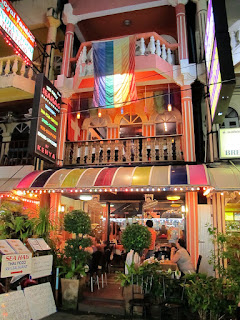 We started our night in Patong with a visit to the legendary Sea Hag restaurant, recommended by several locals, including our guide. The food was stunning. I can't remember how many different dishes we had, or what their Thai names were, but I have not had better seafood in Thailand.
We looked at menus for ten minutes or so, and when we were ready to order, or host, Khun Kenya, ignored all our selections, and chose a veritable smorgasboard of Thai dishes that were so full of flavour and all so different. Some were spicy, but none painfully so.
Baked whole fish in tamarind, mixed seafood cooked in a claypot, a fish mousse, and huge prawns wrapped in super thin noodles and deep-fried. Wow! And for us, a very cheap feed indeed. I hate leaving food on a plate, and will often stuff myself so food doesn't go to waste (but instead to my waist) - but there was no way I could eat another mouthful, and some of our security guards got some great leftovers that night.
With our taste buds truly satiated, it was time for a full-on assault of our other senses. The sights, sounds, and yes, smells of Bangla Road.
I've never seen so many Australians in one street before. It was like being a kid lost at Sydney's Royal Easter Show again. Of course there were also Britts, Russians, Americans, those from the Middle East, and various other assorted nationalities.
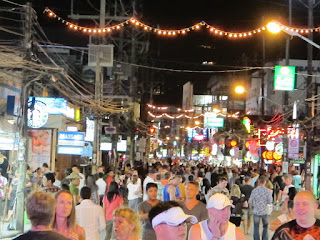
All in one main street - and its various sois - being coaxed into bars, urged to look at menus of the performances available in some of those bars, and huddling around groups of katoey (lady boys) to take photos. You could also purchase various fluorescent toys that flew into the air, wooden frogs that croaked when you stroked their back, tailored suits, DVDs, and the usual cacophony of special offers available to the tourist in Thailand.
How could I describe the scene for you? If you took the cars out of Kings Cross in Sydney and made it for pedestrians only, took out any of the legitimate cafes and other businesses that might operate there during the day and replaced them with bars that have no walls and instead just have bars with seats and bands playing and girls dancing on the bars, and then added about 100 times more people than you get on an average Saturday, swapped the risk of getting stabbed for your wallet with the risk of getting fleeced of the money in your wallet, and put smiles on everyone's faces, than that's pretty much what it's like.
Actually, it's not. I suspect there's nothing like Bangla Road in all the world. It has it's own attraction for some - clubs, shows, girls, lady boys, cheap knock-offs of everything from designer jeans to stun guns... And for others the exact same list would make them want to stay away, or condemn those who work and make their living here. I wonder what Fred Nile would do in a place like Bangla Road? Anyway, I digress.
As a sample, we had our first drink at an ice bar. There's plenty of these around in a lot of cities. Everything is made of ice including the glasses, it's very cold, and you drink vodka shots.
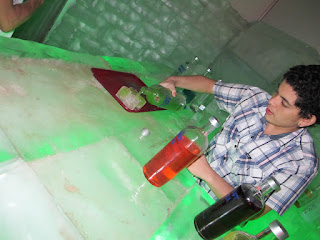
This ice bar turned out to be the freezer room at the back of another bar, where you paid to step out of the hot and humid night air, and into about -15C. We were given drinks in glasses made from ice, which we were told we had to smash against the concrete floor. That was how we started.
It was a truly memorable experience. I've been to bars before, but Bangla Road has a life and spirit of its own. Its not just that there's bars where weird stuff happens, it's that they're all here in one place and everyone knows about it. So everyone comes. Tourists mostly.
In one bar, I even questioned my command of English (let alone Thai), when I order a vodka, lime, and soda, and received a soda, lime, and soda. Or maybe they have that special Thai vodka that tastes like water. Same price though.
The word "exploitation" crept into my head a couple of times as we walked around. But it was more of a question than a comment. I'm not being deliberately naive, but I didn't see unhappy people on either side of the bar, or on the bar. Going back to the Kings Cross parallel, there is a note of desperation there. The stench of drugs and other addictions seep out from behind the lights and glitzy veneer, so you know it's false.
Here there is no veneer. There it is as you walk down the street in front of you - the question is asked in a thousand different ways: "Is this what you want? Well here it is."
I'm not ignorant of the fact that there have been many cases, recent cases, of child and female exploitation in and around Thailand. But so too in Australia, and Britain and America...
Like the beaches and the amazing natural beauty in this country, the tourists come for this, and the tourists spend a lot of money because of this.
D.
This is where I need to touch on some racier topics, so if you're easily offended or don't want to lose your image of me as a sweet, innocent, 42-year-old, then perhaps you can skip to the next article where I document some of Phi Phi islands wildlife, and not Patong Beach's nightlife. You will however, miss a great restaurant review - it's up to you.
OK. All of that said, it's not like I was running naked down the main tourist strip of Patong. You need a licence for that sort of thing, or at least an understanding with some of the local law enforcement representatives.
My guide on this mid-week sojourn into Phuket's most famous (sometimes infamous) street was an expert. A man who has lived here for about 16 years, and actually gets paid by some crazy company to write about and review this area of Thailand (along with others) so that people all around the world will know what to expect when they get here. Where to go, where not to go, and how to avoid buying a round of drinks for everyone in the bar. All good stuff to know.
 We started our night in Patong with a visit to the legendary Sea Hag restaurant, recommended by several locals, including our guide. The food was stunning. I can't remember how many different dishes we had, or what their Thai names were, but I have not had better seafood in Thailand.
We looked at menus for ten minutes or so, and when we were ready to order, or host, Khun Kenya, ignored all our selections, and chose a veritable smorgasboard of Thai dishes that were so full of flavour and all so different. Some were spicy, but none painfully so.
Baked whole fish in tamarind, mixed seafood cooked in a claypot, a fish mousse, and huge prawns wrapped in super thin noodles and deep-fried. Wow! And for us, a very cheap feed indeed. I hate leaving food on a plate, and will often stuff myself so food doesn't go to waste (but instead to my waist) - but there was no way I could eat another mouthful, and some of our security guards got some great leftovers that night.
With our taste buds truly satiated, it was time for a full-on assault of our other senses. The sights, sounds, and yes, smells of Bangla Road.
I've never seen so many Australians in one street before. It was like being a kid lost at Sydney's Royal Easter Show again. Of course there were also Britts, Russians, Americans, those from the Middle East, and various other assorted nationalities.

All in one main street - and its various sois - being coaxed into bars, urged to look at menus of the performances available in some of those bars, and huddling around groups of katoey (lady boys) to take photos. You could also purchase various fluorescent toys that flew into the air, wooden frogs that croaked when you stroked their back, tailored suits, DVDs, and the usual cacophony of special offers available to the tourist in Thailand.
How could I describe the scene for you? If you took the cars out of Kings Cross in Sydney and made it for pedestrians only, took out any of the legitimate cafes and other businesses that might operate there during the day and replaced them with bars that have no walls and instead just have bars with seats and bands playing and girls dancing on the bars, and then added about 100 times more people than you get on an average Saturday, swapped the risk of getting stabbed for your wallet with the risk of getting fleeced of the money in your wallet, and put smiles on everyone's faces, than that's pretty much what it's like.
Actually, it's not. I suspect there's nothing like Bangla Road in all the world. It has it's own attraction for some - clubs, shows, girls, lady boys, cheap knock-offs of everything from designer jeans to stun guns... And for others the exact same list would make them want to stay away, or condemn those who work and make their living here. I wonder what Fred Nile would do in a place like Bangla Road? Anyway, I digress.
As a sample, we had our first drink at an ice bar. There's plenty of these around in a lot of cities. Everything is made of ice including the glasses, it's very cold, and you drink vodka shots.

This ice bar turned out to be the freezer room at the back of another bar, where you paid to step out of the hot and humid night air, and into about -15C. We were given drinks in glasses made from ice, which we were told we had to smash against the concrete floor. That was how we started.
It was a truly memorable experience. I've been to bars before, but Bangla Road has a life and spirit of its own. Its not just that there's bars where weird stuff happens, it's that they're all here in one place and everyone knows about it. So everyone comes. Tourists mostly.
In one bar, I even questioned my command of English (let alone Thai), when I order a vodka, lime, and soda, and received a soda, lime, and soda. Or maybe they have that special Thai vodka that tastes like water. Same price though.
The word "exploitation" crept into my head a couple of times as we walked around. But it was more of a question than a comment. I'm not being deliberately naive, but I didn't see unhappy people on either side of the bar, or on the bar. Going back to the Kings Cross parallel, there is a note of desperation there. The stench of drugs and other addictions seep out from behind the lights and glitzy veneer, so you know it's false.
Here there is no veneer. There it is as you walk down the street in front of you - the question is asked in a thousand different ways: "Is this what you want? Well here it is."
I'm not ignorant of the fact that there have been many cases, recent cases, of child and female exploitation in and around Thailand. But so too in Australia, and Britain and America...
Like the beaches and the amazing natural beauty in this country, the tourists come for this, and the tourists spend a lot of money because of this.
D.
Subscribe to:
Posts (Atom)